
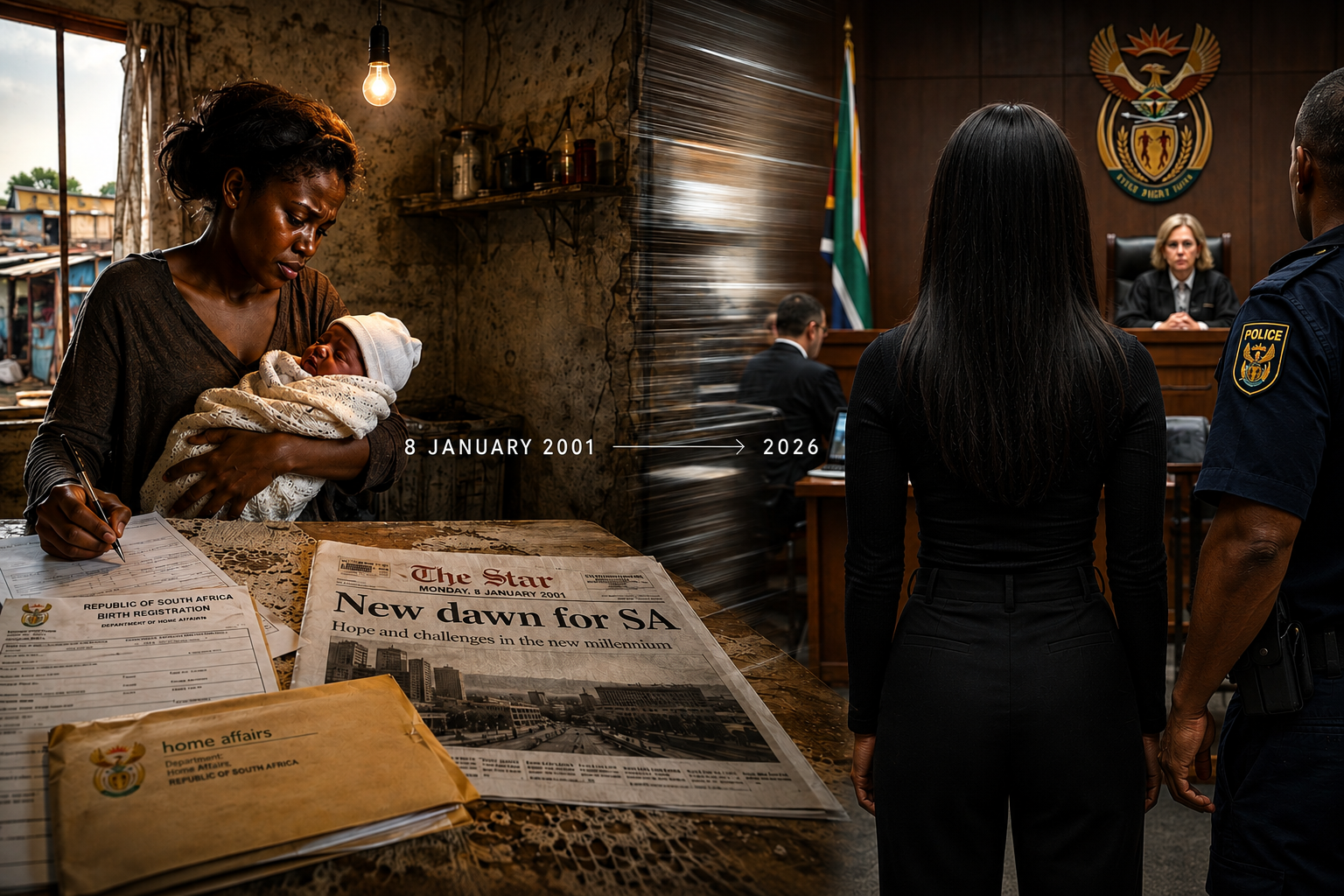
The Chidimma Adetshina case has generated enormous public attention in South Africa, much of it focused on nationality, beauty pageants, citizenship and, more recently, possible deportation. Behind all that noise, however, sits a much more interesting immigration-law question: can South Africa make an adult carry the consequences of alleged fraud committed by somebody else when she was an infant, particularly when she subsequently spent much of her life relying on documents issued by the South African state?
That question becomes particularly uncomfortable when one considers what the Department of Home Affairs itself said when it announced the preliminary findings of its investigation in August 2024.
Home Affairs reported that it had found prima facie indications that fraud and identity theft may have been committed by the person recorded as Adetshina’s mother. At the same time, the Department expressly acknowledged that “Adetshina could not have participated in the alleged unlawful actions of her mother, as she was an infant at the time.” Home Affairs also indicated that its investigation included examining whether departmental officials had been involved in the alleged fraudulent scheme.
That gives us a rather extraordinary starting point. The state alleges that fraud occurred, while simultaneously acknowledging that the child at the centre of the resulting identity could not possibly have participated in it. That child subsequently became an adult, and she is now living with the consequences.
Why was Chidimma Adetshina declared a prohibited person?
Adetshina was reportedly declared a prohibited person on 19 December 2024 under the Immigration Act. The term “prohibited person” has a particular legal meaning and should not be confused with the more commonly discussed concept of an “undesirable person”.
Section 29 of the Immigration Act identifies various categories of foreigners who are prohibited persons. A person falling within these categories generally does not qualify for admission to South Africa, a visa or permanent residence while their prohibited status remains in place.
Of particular relevance to this case is section 29(1)(f), which includes a person found in possession of a fraudulent visa, passport, permanent residence permit or identification document.
Recent court reporting has provided some insight into Home Affairs’ position. In an affidavit quoted by the Sunday Times, a Home Affairs immigration official reportedly described Adetshina’s status as the “fruit of a poisoned tree”, flowing from what the Department alleges was the fraudulent registration of her birth.
Adetshina disputes Home Affairs’ position and is challenging decisions affecting her status. We do not presently have the complete heads of argument in the High Court review publicly available, and for that reason we should be careful about presenting media reports as though they represent every legal argument being advanced by either side.
The courts will ultimately determine the legal issues before them. There is, however, already enough information in the public domain to examine the wider immigration questions raised by the case.
Can someone be declared prohibited because of fraud committed by somebody else?
This is where things become particularly interesting.
Section 29(1)(f) refers to a person who is “found in possession” of certain fraudulent documents. The wording does not expressly state that the person possessing the document must also have been the person who created the fraud.
That potentially creates an extraordinary situation for somebody in Adetshina’s position. She was an infant when the alleged conduct occurred and obviously played no role in registering her own birth, determining what information was entered into Home Affairs’ systems, or issuing the identity and travel documents that subsequently followed. Those actions were undertaken by adults and ultimately processed through institutions of the South African state.
So what exactly was the child supposed to do? Audit her mother’s citizenship history? Investigate the circumstances surrounding her own birth registration? Ask Home Affairs whether documents issued by Home Affairs itself were actually legitimate?
Of course not. She was a child.
The legal question surrounding prohibited status will have to be determined according to the Immigration Act and the facts ultimately established in court. But from an administrative fairness perspective, the absence of any agency on the part of the child is difficult to ignore.
Can prohibited-person status be lifted in South Africa?
Yes. The Immigration Act itself provides a mechanism through which prohibited status may potentially be lifted.
Section 29(2) gives the Director-General of Home Affairs the power, for good cause, to declare a person contemplated in section 29(1) not to be a prohibited person. The legislation therefore recognises that simply establishing that someone falls within one of the categories in section 29(1) does not necessarily have to end the enquiry.
Whether Adetshina meets the legal requirements for such relief is a matter for the appropriate decision-maker and, where challenged, the courts. Nevertheless, the circumstances surrounding her case are plainly unusual. She was an infant when the alleged fraud occurred; Home Affairs itself acknowledges that she could not have participated in it; she subsequently relied on documentation produced through the state’s own systems; and the Department itself previously indicated that it was investigating whether any of its officials had participated in the alleged scheme.
These are hardly ordinary circumstances.
Home Affairs cannot disappear from its own story
This, for me, is where the case becomes much bigger than Chidimma Adetshina.
If Home Affairs ultimately proves its allegations against her mother, then the person responsible for the fraud should face whatever consequences the law provides. There should be no controversy about that.
But there is another question that deserves equal attention: how did the state’s own systems allow this to happen?
Home Affairs administers the National Population Register, birth registration, identity documentation, passports and citizenship. It is therefore not some distant observer in this story. It is the institution responsible for the administrative systems through which Adetshina’s disputed identity was created and maintained.
If the Department’s allegations are ultimately proved, then somewhere along that chain something went badly wrong. Officials may have been deceived. Administrative controls may have been inadequate. There may have been deliberate wrongdoing. Officials themselves may conceivably have been involved. These questions require evidence and proper investigation, and no conclusion should be reached without it.
What we can say with considerably greater confidence is that the infant had no control over any of those events.
That infant became a child, then a teenager and eventually an adult, apparently believing that the identity recognised by the South African state was hers. If official documents were issued and accepted for years before the alleged underlying problem was identified, it is legitimate to ask at what point the state accepts some responsibility for the consequences of its own administrative history.
Accountability must work both ways
South Africa has every right to protect the integrity of its citizenship and immigration systems. Fraud must be investigated, fraudulent documents must be dealt with, and people who deliberately manipulate government systems should face the consequences.
But accountability cannot operate in only one direction.
If an individual committed fraud, hold that individual accountable. If officials participated in wrongdoing, hold them accountable too. If government systems failed, establish why they failed and fix them.
What is much harder to justify is treating an infant as though she had meaningful agency in the original transaction.
Home Affairs itself has already acknowledged that she did not.
And this is where I struggle with the idea that the state can simply wash its hands of what happened afterwards. If South Africa registered a child’s birth, maintained records relating to that child, issued official documentation and allowed her to build a life around the resulting identity, then discovering an alleged historical fraud decades later creates something more complicated than an administrative correction.
There is a human being attached to that record.
None of this automatically makes Adetshina a South African citizen. It does not excuse any subsequent immigration contraventions that may ultimately be established, nor does innocence in relation to an original fraud automatically create a right to remain permanently in South Africa.
But surely the answer cannot simply be: your mother allegedly committed fraud, our systems allowed it, you were an infant, you grew up relying on documents issued through those systems, and now that you’re an adult the consequences are entirely yours.
That is far too convenient.
What happens if Chidimma Adetshina is ultimately found not to be a South African citizen?
There is another layer to the case that is easily lost in the public debate. Citizenship and immigration status are separate legal questions.
Even if a court ultimately concludes that Adetshina is not a South African citizen, it does not necessarily follow that every possible legal avenue for remaining lawfully in South Africa disappears.
One possible mechanism already exists within section 29 itself. Under section 29(2), the Director-General may, for good cause, declare a person not to be prohibited.
The Immigration Act also contains broader discretionary powers under section 31. Section 31(2)(b), for example, allows the Minister of Home Affairs to grant a foreigner rights of permanent residence where special circumstances exist that would justify such a decision. Section 31(2)(c) separately provides for the waiver of prescribed requirements or forms for good cause.
These are discretionary powers, not automatic rights. Nothing in section 31 guarantees Adetshina permanent residence or gives her an automatic entitlement to remain in South Africa.
What the provisions demonstrate, however, is that South African immigration law contains mechanisms designed to accommodate circumstances that cannot always be resolved neatly through the ordinary immigration categories.
If this isn’t exceptional, what is?
Consider the position from the child’s perspective.
A child is born and her birth is registered. She grows up with an identity recognised by the state and receives official South African documentation. She proceeds through childhood and into adulthood believing that the legal identity recorded by the government is hers.
Then, as an adult, she discovers that the foundation beneath that identity is being challenged because of something allegedly done when she was an infant.
There may ultimately be perfectly sound legal reasons why citizenship cannot survive an original fraud. That is a question for the courts and must be determined according to the relevant citizenship legislation and established facts.
But South African immigration law provides mechanisms for discretion and relief precisely because individual circumstances cannot always be resolved through rigid administrative outcomes.
If Adetshina ultimately needs to establish a lawful immigration status rather than citizenship, the extraordinary history of how she arrived at that position should, in our view, form part of the consideration of what happens next.
What responsibility does Home Affairs have?
Perhaps this is the question that interests me most.
Home Affairs is simultaneously the institution challenging the legitimacy of Adetshina’s documentation and the institution responsible for the systems through which that documentation was created, maintained and apparently recognised for years.
That does not make Home Affairs responsible for another person’s alleged fraud. Nor should administrative failures, if established, somehow convert an unlawful status into citizenship by default.
But government should be prepared to examine whether failures within its own systems materially contributed to the situation now confronting the person concerned.
Home Affairs itself acknowledged in 2024 that the Adetshina investigation highlighted the need to modernise its systems to protect them against fraudulent interference.
If a government system fails to detect alleged fraud for years and an innocent child consequently builds her life around an identity produced through that system, fairness surely requires something more sophisticated than correcting the database decades later and walking away.
So who should carry the consequences?
The litigation surrounding Chidimma Adetshina remains ongoing. The facts are contested, the complete High Court heads of argument are not presently available to us, and nothing in this article should be interpreted as predicting how a court will determine her citizenship, prohibited status or ultimate right to remain in South Africa.
But one important fact comes directly from Home Affairs itself: Adetshina was an infant and could not have participated in her mother’s alleged unlawful actions.
That leaves South Africa with a question extending far beyond one highly publicised case.
What should happen when a child innocently builds a life around an identity recognised and documented by the state, only for the state decades later to discover that the identity may have originated in somebody else’s fraud?
The person who committed the fraud should answer for the fraud. The state should answer for any failures established within its own systems. And the innocent child who became an adult deserves something more sophisticated than simply being handed the bill for both.
Frequently Asked Questions
Why was Chidimma Adetshina declared a prohibited person?
Adetshina was reportedly declared prohibited under South Africa’s Immigration Act after Home Affairs challenged the legitimacy of documentation associated with her status. Section 29(1)(f) includes a person found in possession of certain fraudulent immigration or identification documents. Decisions affecting her status remain the subject of litigation.
What is a prohibited person under South African immigration law?
Section 29 of the Immigration Act identifies categories of foreigners regarded as prohibited persons. A prohibited person generally cannot qualify for admission, a visa or permanent residence while that status remains in place.
Can prohibited-person status in South Africa be lifted?
Yes. Section 29(2) allows the Director-General of Home Affairs, for good cause, to declare a person contemplated in section 29(1) not to be prohibited.
What is a section 31 exemption in South Africa?
Section 31 of the Immigration Act gives the Minister of Home Affairs various discretionary powers. These include, in specified circumstances, granting rights of permanent residence and waiving prescribed requirements or forms. The existence of these powers does not mean that any particular applicant is automatically entitled to an exemption.
Did Home Affairs say Chidimma Adetshina committed the original alleged fraud?
No. In its August 2024 statement, Home Affairs expressly said that Adetshina could not have participated in her mother’s alleged unlawful actions because she was an infant at the time.
Has the High Court finally decided Chidimma Adetshina’s challenge?
As at 23 August 2026, the litigation relevant to the issues discussed in this article remains unresolved. We also do not presently have the complete heads of argument in the High Court review available to us.
Gema Visa Services Perspective
Gema Visa Services advises individuals, families and businesses on South African immigration matters, including prohibited-person status, visa and residency matters, immigration compliance and representations involving the Department of Home Affairs. Cases such as Chidimma Adetshina’s illustrate how questions of immigration status can extend far beyond the original conduct that caused the problem, particularly where identity, citizenship, administrative action and the rights of an affected individual intersect.
Sources and further reading
Department of Home Affairs — Home Affairs investigation finds prima facie indications of fraud committed by Chidimma Adetshina’s mother, August 2024.
Immigration Act 13 of 2002 — particularly sections 29 and 31.
Parliament of South Africa — public statements concerning the Home Affairs investigation and possible official involvement.
Publicly reported court proceedings concerning Adetshina’s prohibited-person status and related litigation.
This article discusses an ongoing legal matter based on legislation, official government statements and information presently available in the public domain. Allegations remain allegations unless established by a court or admitted by the relevant party.
Leave a Reply